


JAI Wave Series
SWIR Line Scan Cameras for Industrial Inspection
The JAI Wave Series delivers SWIR line scan imaging for industrial inspection at production speed. Designed for applications where material composition, moisture distribution, or subsurface conditions are the inspection variable, it provides the spectral contrast that visible-spectrum cameras cannot.
Key Takeaways
- Reveals material properties invisible to visible-spectrum cameras: moisture distribution, polymer composition, and subsurface defects
- Enables continuous inline inspection at production speed with compact 1K and 2K models
- Distinguishes materials with near-identical visible appearance through high spectral sensitivity and 14-bit output
- Reduces host-side processing requirements through on-camera FFC, DPC, and Destripe image correction
- Fits standard line scan installations: GigE Vision, C-mount optics, compact 60 × 60 mm form factor
What is SWIR Line Scan?
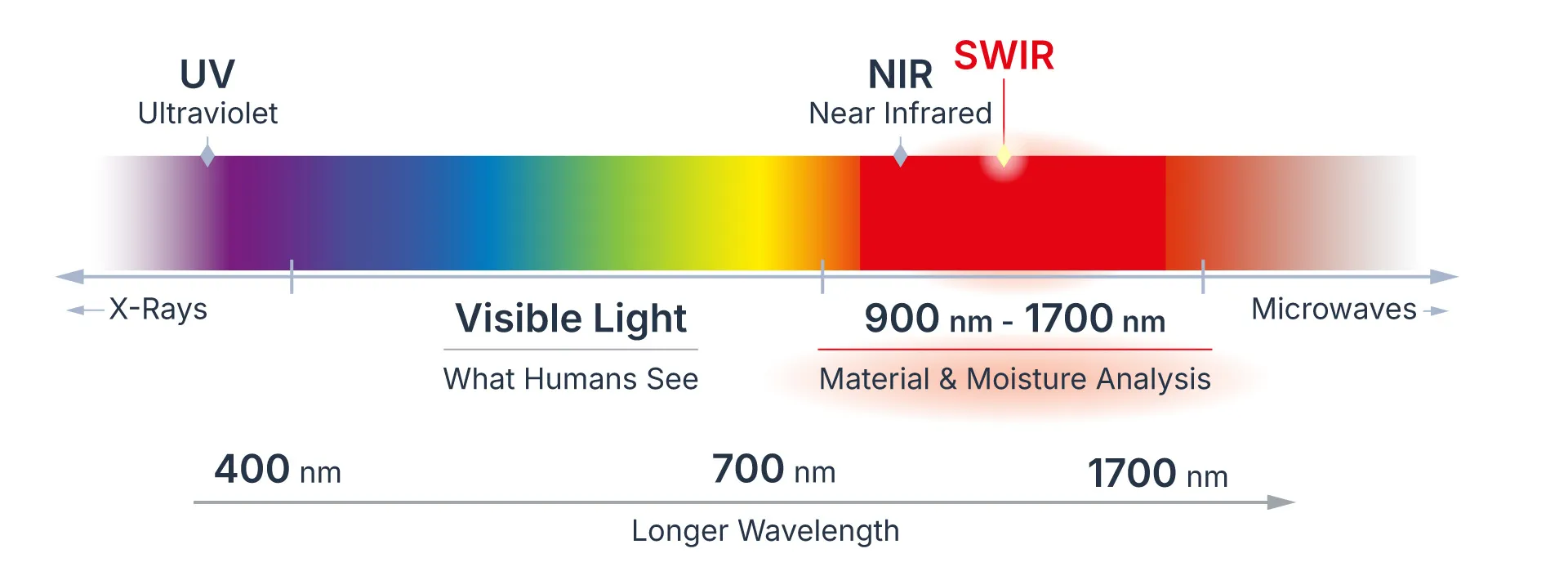
SWIR, short-wave infrared, covers the wavelength range from 900 to 1700 nm, beyond the visible spectrum and the near-infrared range. Capturing light in this range requires InGaAs sensor technology, which responds to the molecular absorption properties of water, organic compounds and polymers that produce no contrast under visible illumination.
Water absorbs SWIR strongly: moisture distribution becomes measurable even in materials that appear uniform in visible light.


Polymers with identical visual appearance show distinct SWIR spectral signatures, enabling automated material classification.


Silicon is partially transparent to SWIR, allowing subsurface cracks and wafer defects to be detected without contact and without damage
Line scan cameras build the image line by line as the object moves through the field of view, the suitable architecture for continuous inspection on conveyors, web material and production lines.
SWIR line scan combines spectral sensitivity to material properties with the throughput needed for inspection at production speed. Line scan architecture is the appropriate choice when inspection targets are always in motion: conveyor belts, web material, and reel-to-reel processes. The JAI Wave Series combines both.
Key Benefits
Spectral Reach Beyond Visible Imaging
InGaAs sensor technology (900–1700 nm) makes material composition, moisture distribution, and subsurface conditions quantifiable inspection variables.
Consistent Image Quality at Line Scan Speed
Large 12.5 µm pixels and 83% peak quantum efficiency maintain reliable image quality at production line rates, even in low-illumination SWIR setups.
Classification Where Contrast Is Narrow
14-bit output keeps subtle spectral differences between similar materials distinguishable where lower bit-depth imaging loses the boundary.
Scalable to Application Requirements
1K (29 kHz) and 2K (40 kHz) configurations share the same sensor width, C-mount compatibility, and GigE Vision interface.
No upgrading from a 1K installation
No external frame grabber required and no changes to optics, illumination, or working distance.
Wide Field of View
12.8 mm sensor width and C-mount optics support to cover two parallel seal lines or multiple conveyor lanes from a single camera position, reducing hardware count on dual-lane packaging and high-throughput sorting lines.
Standard Infrastructure
GigE Vision (1000BASE-T) fits standard line installations and is compatible with CVB Common Vision Blox and JAI SDK.
Cleaner Output, Less Processing Overhead
On-camera FFC, DPC, and Destripe deliver corrected image data to the host, reducing processing overhead and commissioning time.
Built for Industrial Environments
Rated to -20°C/+55°C, 10G vibration, and 80G shock, covering food, packaging, recycling, and semiconductor environments.
Specifications
| Parameter | WAL-1001-GE | WAL-2001-GE | |
|---|---|---|---|
| Sensor | InGaAs (Indium-Gallium-Arsenid) | ||
| Spectral range | 900–1700 nm | ||
| Effective pixels | 1024 × 1 | 2048 × 1 (pixel shift) | |
| Maximum line rate | 29 kHz | 40 kHz | |
| Pixel size | 12.5 × 12.5 µm | ||
| Quantum efficiency | 83% @ 1435 nm (typ.) | ||
| Video output | Mono 8/10/12/14-bit | ||
| Interface | GigE Vision (1000BASE-T) | ||
| Lens mount | C-Mount (BFD: 17.526 mm) | ||
| ISP functions | 1FFC, DPC, Sharpness, Destripe, LUT, Black level | FFC, DPC, Spatial Correction, Destripe, LUT, Black level | |
| Power supply | 12–24 V DC (12-pin connector) | ||
| Operating temperature | -20°C to +55°C | ||
| Dimensions (H × W × D) | 60.0 × 60.0 × 57.6 mm | 60.0 × 60.0 × 55.5 mm |

Application Areas
The Wave Series cameras address inspection challenges in four primary areas where SWIR sensitivity and line scan throughput are required together.

Food Sorting and Grading
Quality classification based on internal condition rather than surface appearance alone. Moisture content, organic compound distribution, and foreign material identification are reliably detectable. The wide field of view achievable with the 12.8 mm sensor and C-mount optics allows a single camera to cover parallel conveyor lanes, reducing hardware count on high-throughput sorting lines.

Semiconductor Wafer Inspection
Silicon transmits SWIR wavelengths, enabling subsurface crack detection, layer uniformity inspection, and alignment verification without contact or destructive testing.

Recycling and Material Sorting
Polymers with identical visible appearance carry distinct SWIR signatures. Line scan imaging classifies mixed plastic streams at sorting speeds, including black and dark plastics not detectable by NIR-based systems.

Packaging Inspection
SWIR backlight illumination reveals the seal zone clearly, making seal width and seal integrity directly measurable. Zipper closures and foreign material inclusions are detectable in the same pass.
STEMMER IMAGING: Supporting Wave Series Deployment
SWIR line scan applications require coordinated selection of camera, illumination, and optics. STEMMER IMAGING’s Technical Competence Centre provides support across all phases of system specification and deployment.
Operational Services
Firmware configuration, camera pre-settings, and commissioning documentation, reducing on-site setup time for Wave Series installations.
Engineering Services
Feasibility testing validates SWIR spectral contrast using actual production material samples before system specification. Technical coaching covers illumination selection, spectral filter pairing, and acquisition parameter optimisation. System design support is available for complete SWIR line scan installations.
Special Solutions & Applications
For multi-camera web inspection layouts, application-specific subsystem development, or SWIR imaging within existing production line control infrastructure: project qualification and development through to series readiness.
Operational Services
Firmware configuration, camera pre-settings, and commissioning documentation, reducing on-site setup time for Wave Series installations.
Engineering Services
Feasibility testing validates SWIR spectral contrast using actual production material samples before system specification. Technical coaching covers illumination selection, spectral filter pairing, and acquisition parameter optimisation. System design support is available for complete SWIR line scan installations.
Special Solutions & Applications
For multi-camera web inspection layouts, application-specific subsystem development, or SWIR imaging within existing production line control infrastructure: project qualification and development through to series readiness.
Frequently Asked Questions
What is SWIR imaging and how does it differ from visible-spectrum and NIR imaging?
SWIR (short-wave infrared) covers the 900–1700 nm wavelength range, beyond the visible spectrum (400–700 nm) and the NIR range accessible to extended-silicon sensors (700–900 nm). Unlike visible and NIR imaging, SWIR captures molecular-level differences in materials, including moisture absorption, organic compound signatures, and polymer composition, that produce no contrast at shorter wavelengths. Standard silicon sensors have no response in SWIR; InGaAs sensors are required.
When is a SWIR line scan camera the right choice for an industrial inspection application?
SWIR line scan cameras are appropriate when the inspection decision depends on material properties producing no useful contrast in the visible or NIR range, and when the production process is continuous. Representative applications include moisture content mapping, polymer classification on conveyor belts, subsurface defect detection in silicon wafers, and fill-level or seal verification through opaque packaging. Where the inspection target is surface appearance or geometry, a standard monochrome or colour camera is generally more cost-effective.
What is the difference between the 1K and 2K configurations in the JAI Wave Series?
The 1K configuration provides 1024 pixels per line at up to 29 kHz. The 2K configuration provides 2048 pixels per line at up to 40 kHz using a dual-row pixel-shift design: two offset 1K sensor rows are combined in-camera in real time, producing an effective pixel pitch of 6.25 × 6.25 µm and enabling sub-pixel defect detection without a native 2K InGaAs sensor. The 2K image is synthesised entirely on-camera, with no external acquisition card required. Both configurations share the same sensor width, lens mount, and GigE Vision interface; upgrading from 1K to 2K requires no changes to optics, illumination, or working distance. Selection between the two depends primarily on the spatial resolution required in the scan direction and the inspection line speed.
What illumination is required for SWIR line scan cameras?
SWIR illumination must emit in the 900–1700 nm range. Common sources include SWIR LEDs, tungsten-halogen lamps, and laser diodes at SWIR wavelengths. Line scan setups require uniform illumination across the scan line; spectral bandpass filters are sometimes used to target specific material absorption features. STEMMER IMAGING supports illumination selection and layout through its Engineering Services.
How does a SWIR line scan camera differ from a SWIR area scan camera?
Line scan cameras build an image line by line as material moves through the field of view, making them the correct choice for conveyor, belt, and web inspection where targets are in continuous motion. Area scan cameras capture a full frame in a single exposure and are better suited to discrete object inspection in controlled stop-and-inspect setups.
Which software is compatible with JAI Wave Series SWIR line scan cameras?
Both configurations use GigE Vision (1000BASE-T) and are compatible with any GigE Vision-compliant acquisition framework. STEMMER IMAGING’s CVB Common Vision Blox provides GigE Vision acquisition, image processing, and analysis in a single development environment. JAI SDK is also available directly.
Is feasibility testing available for SWIR line scan applications?
Yes. STEMMER IMAGING provides feasibility testing through its Engineering Services, validating spectral contrast against actual production material samples before system specification. This is particularly relevant for SWIR applications, where achievable contrast depends on the molecular composition of specific materials and can vary between nominally similar samples.